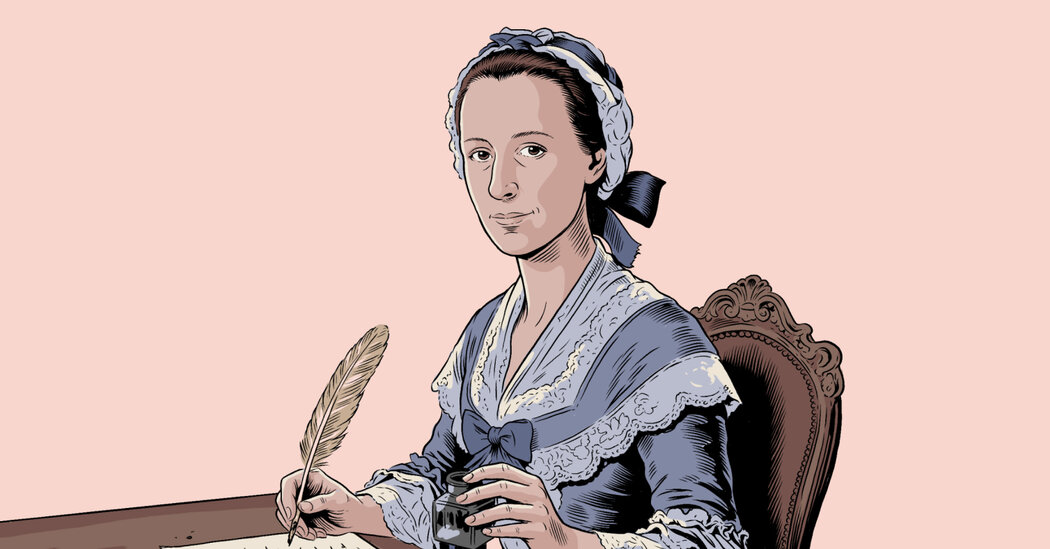
Mercy Otis Warren was among the first writers of the Revolutionary period to define the struggle against Britain as a fight against tyranny. Before Thomas Paine wrote “Common Sense” or Thomas Jefferson penned the Declaration of Independence, Warren helped lay the groundwork by framing the conflict in stirring, dramatic terms. In a series of plays published in the early 1770s, she captivated the reading public by elevating their personal grievances with British rule by using classical tropes and symbolic language.
Warren witnessed growing British power early and up close, and she came to believe that the showdown between the colonists and the British officials who ruled them was no self-interested squabble over taxes. It was instead a fundamental clash between freedom and oppression, with roots going back to the Roman republic. Her plays persuaded many other colonists to see it the same way.
For Warren, this was no intellectual exercise. She and her family had been feuding with Thomas Hutchinson since the mid-1750s, more than a decade before anyone was even thinking of revolution. At that time, when Warren was in her 20s, she had no idea that the colonies would eventually fight to leave the British Empire. She was proud to live in the most powerful, most profitable and what many white colonists saw as the freest empire in the world.
She and her beloved husband, a merchant and politician named James Warren, could afford silk, satin, lace and ribbons for her dresses and imported cheese and wine for their table. James and others in Warren’s family — her brother and her father, both named James Otis — were men of consequence who held positions in the Massachusetts colonial government. Raised in the culture of British New England in Barnstable, Mass., Warren was given the rare chance to be tutored, alongside her brothers, and taught to wield a pen. For the Warrens and the Otises, it was good to be British.
But while the empire made Warren’s comfortable life possible, she and her family hit what we might call a colonial glass ceiling. They blamed Hutchinson. In 1757, Hutchinson, then a member of the Governor’s Council, lobbied against her father’s appointment to the same group. Three years later, the governor appointed Hutchinson as chief justice of the Massachusetts Superior Court, adding to a baffling number of appointments that Hutchinson also racked up, eventually including lieutenant governor of Massachusetts.
In 1761, Warren’s brother, James Otis Jr. — known as Jemmy — argued a case before the Massachusetts Superior Court challenging customs officers’ ability to board ships to search for smuggled goods, saying that the practice violated the British Constitution and the colonial rights to due process. As lieutenant governor, Hutchinson enforced the laws at issue in the case; as chief justice of the Massachusetts Superior Court, he was also the judge. His predictable decision against Otis and the Boston merchants seemed a clear sign of the corruption not only of Hutchinson but also of the relationship between the British government and its colonies.
By 1770, unrest over Parliament’s restrictive policies from the past decade — including the Sugar, Stamp and Declaratory Acts — had spilled out into the streets. That year, five townspeople were killed in the Boston Massacre. King George III, rather than removing Lieutenant Governor Hutchinson over the disaster, promoted him to permanent governor with orders to crack down on the city.
Warren was determined not only to emphasize Hutchinson’s fatal flaws — she later wrote that he “was dark, intriguing, insinuating, haughty and ambitious, while the extreme of avarice marked each feature of his character” — but also to awaken her fellow colonists to the British government’s tyrannical creep. She wrote “The Adulateur” in 1772 and used blank verse, with its iambic pentameter, to make Rapatio’s lines seem to drive toward an inexorable conclusion. The meter makes him not just bad but almost unstoppable as he soliloquizes about his tyrannical ambitions:
Despotic rule my first, my sov’reign wish;
Yet to succeed beyond my sanguine hope,
To quench the gen’rous flame, the ardent love
Of liberty in Servia’s freeborn sons,
Destroy their boasted rights, and mark them slaves.
Even though Warren published the play anonymously, it must have been thrilling for her to see her own words printed — not in the fine cursive of a lady’s handwriting but in the bold type usually reserved for men, with their news of politics and war and their companies’ advertisements for the latest goods from London. Still, she wrote to her friend Hannah Winthrop, she didn’t intend for “The Adulateur” to catch fire the way it did. She had been writing only “to give pleasure to a little circle of very valuable friends” and “never entertained so chimerical an idea as to suppose it in my power greatly to amuse — much less to benefit the world.”
It didn’t take long for leaders of Massachusetts’s rising rebellion to figure out that the author was the wife of their friend James Warren of Plymouth. In December 1773, after the clandestine political group known as the Sons of Liberty dumped 342 chests of tea into Boston Harbor, John Adams wrote to James Warren, asking him to “make my Compliments to Mrs. Warren” and urge her to fight for the cause. Adams hoped that she would write a poem praising the Boston Tea Party: “I wish to See a late glorious Event Celebrated by a certain poetical Pen,” Adams wrote, “which has no equal that I know of in this Country.”
Warren’s works were extraordinary in more ways than one — for being written by a woman and helping push the colonies toward revolution. After the war, Warren would stay true to her belief that the new American government shouldn’t reproduce the old tyrannies of the British, nor should it leave room for the development of new ones. She never abandoned what she saw as her readers’ “ardent love of liberty,” as her first play put it, which she knew was essential to the Revolution in its day — and something that has been central to the American conversation ever since. This commitment to liberty would lead her to oppose the original Constitution, pitting herself against many founding fathers in the process.
The person who most influenced Warren’s political formation was her brilliant older brother, Jemmy. He was known for his passionate defenses of liberty, which he distributed in the political pamphlets he wrote, and for his impetuosity — John Adams called him “a flame of fire.” Back in 1761, Jemmy won a seat in the Massachusetts Assembly and spent many nights with his sister and brother-in-law at their home in Plymouth, which was on the road between the Otis family home in Barnstable and the Assembly in Boston.
In the years before the war, Jemmy also helped attract other frequent visitors, including both John and Samuel Adams, who would help form the Sons of Liberty. Their first steps toward revolution took place on the wooden floors of the Warrens’ living room. At first, Warren might have only listened to the men debating as she poured tea or bent over needlework, but soon she was part of the conversations. After all, she had read the same philosophy and history books that they had. She freely expressed her opinions, as she later wrote to John Adams, “at a Certain Fire side, where many Political plans were Laid, Discussed, and Digested.”
Jemmy’s name might have become as famous as those of John Adams and Thomas Jefferson. But some sort of mental illness came upon him in his 40s. He shouted inappropriate and often incomprehensible insults and got in fights. At first, people thought it was just his hot temper and heavy drinking. But by 1771, he was declared mentally incompetent and moved to his parents’ house in Barnstable. Growing up together, the siblings had been taught that women were as intellectually capable as men, yet Warren had never planned to write for anyone beyond family and friends. Now she believed that the movement had lost its best defender. She took up her brother’s pen.
The Warrens and the Sons of Liberty wanted to stoke the revolutionary spirit. What started in Boston had broadened to the rest of Massachusetts, but they needed to reach the other British colonies, too. Through newly devised Committees of Correspondence — small groups in each town and county that spread news, coordinated action and enforced the boycotts of British goods — they distributed a bombshell in 1773: a damning trove of Hutchinson’s letters that Benjamin Franklin had received from an anonymous source, in which Hutchinson mused that the government might need to crack down on colonists’ liberties. The letters made their way to the Warren home, where the Warrens and the Adamses decided that this was the chance to lay bare the British plot against liberty. Once leaked, the letters were read aloud in the Massachusetts Assembly, published in newspapers and spread through the committees. “The duplicity of Mr. Hutchinson,” Warren wrote, was “laid open,” and “debates and animosities ran high.” The Assembly began to draw up articles of impeachment against Hutchinson.
Warren began churning out more work, goading her readers to see that “government and legislation were instituted for the benefit of society at large, not for the emolument of a few.” When men like Hutchinson seized too much power, she wrote, it was the people’s “indispensable duty to resist.” And while still anonymous, she wanted to control her work. After someone added to her scenes that ran in The Massachusetts Spy and published a full-length version — in what she justifiably deemed a “plagiary” — Warren wrote an expanded set of scenes for a new play. She published this work as “The Defeat” in The Boston Gazette and Country Journal. One of the “Virtuous Senators” of Warren’s imagined state, Servia, asks in a rhymed couplet:
Shall Servia bleed, and shan’t her sons complain,
While traitors revel o’er her children slain?
The Virtuous Senators together bring about Rapatio’s downfall, as the play’s title predicts. Abigail Adams, John’s wife, praised the play that “so throughly look’d thro the Deeds of Men, and Develloped the Dark designs of a Rapatio Soul.”
After watching the revolutionary ideas she wove into her writing explode throughout the colonies, Warren no longer questioned whether to publish her writing. The poem she wrote praising the Boston Tea Party at John Adams’s request appeared on the front page of The Boston Gazette in early 1774. She wrote another play in early 1775 called “The Group,” which was reprinted in newspapers in New York and Philadelphia. It brutally mocked loyalists as sycophants; it urged colonists who were still on the fence to stand behind Massachusetts, which was suffering under occupation by thousands of British troops and the forced closure of the port of Boston. (The play was so successful that, after the Revolution, a man claimed that he had written it, and Warren had to ask John Adams to publicly spread the word that he knew that she was the true author.)
All people of sense, Warren implied in her writings, were repelled by tyranny, whether that of a violent husband, a cruel slave owner, a power-seizing official or a government that stripped the people of their self-rule. She warned that tyrants should beware: Those on the side of liberty were “resolv’d to die, or see their country free.” As the war started, James Warren became the paymaster of the Continental Army. The colonies went to war, and his wife often traveled to meet him.
Throughout the war, when she wasn’t at her desk or visiting her husband, Warren ran the family farm. Like many Revolutionary wives, she would sometimes move herself and the children to be closer to wherever he needed to be. But she kept up correspondences with the influential people she had hosted in her living room, and after the war she continued to play a central role in Americans’ discussions about how to, as Thomas Paine put it, “begin the world over again.”
Winning independence did not end Warren’s worries about tyranny. In fact, she feared that the new nation’s leaders might forget the Revolution and, in their triumph, blindly recreate a new form of oppressive government. If toppling British control was worth fighting for, reinstituting tyranny with their newfound independence would be heartbreaking.
In 1787, the Continental Congress met in Philadelphia to draft a new governing document to replace the weak Articles of Confederation. Warren wrote that she was alarmed that no press was allowed in to observe the proceedings, “lest their consultations and debates should be viewed by the scrutinizing eye of a free people.” Based on scattered reports she heard from Philadelphia, the men writing the document were recreating tyranny by drafting a Constitution that neglected to mention freedom of the press, ordered elections to be held too infrequently and created a standing army, which would remain a threat to the populace.
In response, Warren published “Observations on the New Constitution, and on the Federal and State Conventions, By a Columbian Patriot” — a work that lambasted “the secret transactions of the convention at Philadelphia.” Behind those closed doors, she charged, a Constitution had been drafted that concentrated power over the states and the people. Was this any different from what had allowed Hutchinson to reign over Massachusetts? She criticized the delegates for not including “a bill of rights to guard against the dangerous encroachments of power,” especially on individual rights. Many of the states’ own constitutions written during the Revolution included this kind of list of protections, and Warren knew that without one for the burgeoning nation, the union could drift into a homegrown version of the British tyranny it had just defeated.
In response to criticism from Warren and others, James Madison and other framers promised that one of the new Congress’s first acts would be to protect individual liberties. Congress indeed passed a series of amendments that were ratified in 1791 and became known as the Bill of Rights. As Warren wrote, Americans could now be more confident that the ideals of the Revolution would persist — and that “the government of the United States stood on a basis which rendered the people respectable abroad and safe at home.”
Since declaring independence, Americans have continued to argue over the right balance between liberty and order. While Alexander Hamilton believed that a republic could never be accused of tyranny — because it represented the will of the people — Warren knew that tyranny could come from many places, including the elected officials we choose to represent us. Liberty can always be taken away, even from within a democracy.
Warren’s defense of liberty and distrust of the powerful has become a recurring part of the American conversation. The Bill of Rights, and the court systems that evolved to protect those rights, proved essential to defending countless Americans over the centuries, including journalists, people accused of crimes and those using the rights of free speech and assembly. In our lifetimes, activists from the Tea Party of the late 2000s to today’s No Kings movement have echoed her ideas: Americans must always be attuned to the concentration of power and the possibility of, as Warren put it, “uncontrouled despotism.” She was always on the side of liberty.
And yet Warren herself has been almost forgotten. There have been a few biographies, including the excellent “A Woman’s Dilemma: Mercy Otis Warren and the American Revolution,” by Rosemarie Zagarri, a historian at George Mason University. But general histories, whether popular accounts of famous revolutionaries or academic analyses of the war’s causes and consequences, mention Warren in a sentence or two, if at all, and almost never as a mover of early Revolutionary thought and action.
In 1790, at age 61, Warren finally published under her own name. It was a collection of poems and plays, some previously published anonymously; unlike her prior work, she was able to register the book’s copyright under Congress’s new copyright law, one of the few instances in which, as a woman, she could legally own property. Alexander Hamilton wrote to congratulate her: “In the career of dramatic composition at least, female genius in the United States has outstripped the Male.”
She also wrote one of the first histories of the Revolution. The book begins with an explanation of why a woman was the right person to write it. “At a period when every manly arm was occupied, and every trait of talent or activity engaged, either in the cabinet or the field,” she wrote, “many circumstances might escape the more busy and active members of society.” Busy with the work of war, men might not have taken in or had the time to jot down all the events “that flowed in quick succession.” Only a woman — and only a woman in the United States with an education, living and publishing in the heart of the Revolution’s action — could write the detailed history from personal experience that the country deserved.
Perhaps a woman, too, was best positioned to observe the fragile nature of liberty, the obligation to constantly protect it and the need of never taking it for granted. As with all wars, the Revolution had tremendous consequences for colonial women, who saw their homes and lives overturned. They had opinions about how societies should run, when they should go to war and when they should make peace. And Mercy Otis Warren wrote hers down.